| Specifications |
PicoScope 5000 Series oscilloscope specifications
| Model |
PicoScope |
| Bandwidth (–3 dB) |
60 MHz |
100 MHz |
200 MHz |
| 2 channel |
5242D |
5242D MSO |
5243D |
5243D MSO |
5244D |
5244D MSO |
| 4 channel |
5442D |
5442D MSO |
5443D |
5443D MSO |
5444D |
5444D MSO |
| Oscilloscope - vertical |
| Input type |
Single-ended, BNC connector |
| Bandwidth (–3 dB) |
60 MHz |
100 MHz[1] |
200 MHz[1] |
| Rise time (calculated) |
5.8 ns |
3.5 ns[1] |
1.75 ns[1] |
| Bandwidth limiter |
20 MHz, selectable |
| Vertical resolution[2] |
8, 12, 14, 15 or 16 bits |
| LSB size[2] (quantization step size) |
8 bit mode: < 0.6% of input range
12 bit mode: < 0.04% of input range
14 bit mode: < 0.01% of input range
15 bit mode: < 0.005% of input range
16 bit mode: < 0.0025% of input range |
| Enhanced vertical
resolution |
Hardware resolution + 4 bits |
| Input ranges |
±10 mV to ±20 V full scale, in 11 ranges |
| Input sensitivity |
2 mV/div to 4 V/div (10 vertical divisions) |
| Input coupling |
AC / DC |
| Input characteristics |
1 MΩ ± 1% || 14 ±1 pF |
| Gain accuracy |
12 to 16 bit modes: ±0.5% of signal ±1 LSB[3]
8 bit mode: ±2% of signal ±1 LSB[3] |
| Offset accuracy |
±500 µV ±1% of full scale[3]
Offset accuracy can be improved by using the “zero offset” function in PicoScope 6. |
| Analog
offset range (vertical position adjust) |
±250 mV (10, 20, 50, 100, 200 mV ranges),
±2.5 V (500 mV, 1 V, 2 V ranges),
±20 V (5, 10, 20 V ranges) |
| Analog offset control accuracy |
±0.5% of offset setting, additional to basic DC offset accuracy
|
| Overvoltage protection |
±100 V (DC + AC peak) |
[1] In 16-bit mode, bandwidth reduced to 60 MHz and rise time increased to 5.8 ns.
[2] On ±20 mV range, in 14 to 16-bit modes, hardware resolution reduced by 1 bit. On ±10 mV
range, hardware resolution reduced by 1 bit in 12-bit mode, 2 bits in 14 to 16-bit modes.
[3] Between 15 and 30 °C after 1 hour warm-up.
| Vertical (digital channels) – D MSO models only |
| Input channels |
16 channels (2 ports of 8 channels each) |
| Input connector |
2.54 mm pitch, 10 x 2 way connector |
| Maximum input frequency |
100 MHz (200 Mbit/s) |
| Minimum detectable pulse width |
5 ns |
| Input impedance |
200 kΩ ±2% || 8 pF ±2 pF |
| Input dynamic range |
±20 V |
| Threshold range |
±5 V |
| Threshold grouping |
Two independent threshold controls. Port 0: D0 to D7, Port 1: D8
to D15 |
| Threshold selection |
TTL, CMOS, ECL, PECL, user-defined |
| Threshold accuracy |
< ±350 mV including hysteresis |
| Threshold hysteresis |
< ±250 mV |
| Minimum input voltage swing |
500 mV peak to peak |
| Channel-to-channel skew |
2 ns, typical |
| Minimum input slew rate |
10 V/µs |
| Overvoltage protection |
±50 V (DC + AC peak) |
| Horizontal |
Max. sampling rate
Any 1 channel
Any 2 channels
Any 3 or 4 channels
More than 4 channels |
8-bit mode
1 GS/s
500 MS/s
250 MS/s
125 MS/s |
12-bit mode
500 MS/s
250 MS/s
125 MS/s
62.5 MS/s |
14-bit mode
125 MS/s
125 MS/s
125 MS/s
62.5 MS/s |
15-bit mode[4]
125 MS/s
125 MS/s |
16-bit mode[4]
62.5 MS/s |
"Channel" means any analog channel or 8-bit digital port
[4]Any number of 8-bit digital ports can be used in 15-bit and 16-bit modes
without affecting the maximum sampling rate
|
| Maximum equivalent sampling rate (repetitive signals; 8-bit mode only, ETS
mode) |
2.5 GS/s |
5 GS/s |
10 GS/s |
| Maximum sampling rate (continuous USB streaming into PC
memory)[5] |
USB 3, using PicoScope 6: 15 to 20 MS/s
USB 3, using PicoSDK: 125 MS/s (8-bit) or 62.5 MS/s (12 to 16 bit modes)
USB 2, using PicoScope 6: 8 to 10 MS/s
USB 2, using PicoSDK: ~30 MS/s (8-bit) or ~15 MS/s (12 to 16 bit modes) |
| Timebase ranges (real time) |
1 ns/div to 5000 s/div in 39 ranges |
| Fastest timebase (ETS) |
500 ps/div |
200 ps/div |
100 ps/div |
| Buffer memory[6] (8-bit mode) |
128 MS |
256 MS |
512 MS |
| Buffer memory[6] (≥ 12-bit mode) |
64 MS |
128 MS |
256 MS |
| Buffer memory[7] (continuous streaming) |
100 MS in PicoScope software |
| Waveform buffer (no. of segments) |
10 000 in PicoScope software |
| Waveform buffer (no. of segments) when using PicoSDK (8 bit mode) |
250 000 |
500 000 |
1 000 000 |
| Waveform buffer (no. of segments) when using PicoSDK (12 to 16 bit modes)
|
125 000 |
250 000 |
500 000 |
| Initial timebase accuracy |
±50 ppm (0.005%) |
±2 ppm (0.0002%) |
±2 ppm (0.0002%) |
| Timebase drift |
±5 ppm/year |
±1 ppm/year |
±1 ppm/year |
| Sample jitter |
3 ps RMS, typical |
| ADC sampling |
Simultaneous on all enabled channels |
[5]Shared between enabled channels, PC dependent, available sample rates vary by
resolution.
[6]Shared between enabled channels.
[7]Driver buffering up to available PC memory when using PicoSDK. No limit on duration of
capture.
| Dynamic performance (typical; analog channels) |
| Crosstalk |
Better than 400:1 up to full bandwidth (equal voltage ranges) |
| Harmonic distortion |
8-bit mode: −60 dB at 100 kHz full scale input.
12-bit mode or higher: −70 dB at 100 kHz full scale input
|
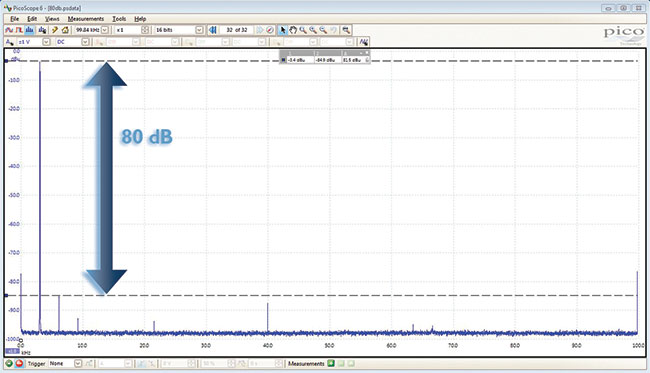
| SFDR |
8 to 12-bit modes: 60 dB at 100 kHz full scale input.
14 to 16-bit modes: 70 dB at 100 kHz full scale input. |
| Noise (on most sensitive range) |
8-bit mode: 120 μV RMS
12-bit mode: 110 μV RMS
14-bit mode: 100 μV RMS
15-bit mode: 85 μV RMS
16-bit mode: 70 μV RMS |
| Bandwidth flatness |
(+0.3 dB, –3 dB) from DC to full bandwidth |
| Triggering (main specifications) |
| Source |
Analog channels, plus: MSO models: Digital D0 to D15. Other models: Ext
trigger. |
| Trigger modes |
None, auto, repeat, single, rapid (segmented memory). |
| Advanced trigger types (analog channels) |
Edge, window, pulse width, window pulse width, dropout, window dropout,
interval, runt, logic. |
| Trigger types (analog channels, ETS) |
Rising or falling edge ETS trigger available on ChA only, 8-bit mode only.
|
| Trigger sensitivity (analog channels) |
Digital triggering provides 1 LSB accuracy up to full bandwidth of scope.
|
| Trigger sensitivity (analog channels, ETS) |
At full bandwidth: typical 10 mV peak to peak |
| Trigger types (digital inputs) |
MSO models only: Edge, pulse width, dropout, interval, logic, pattern, mixed
signal. |
| Maximum pre-trigger capture |
Up to 100% of capture size. |
| Maximum post-trigger delay |
Zero to 4 billion samples, settable in 1 sample steps (delay range on
fastest timebase of 0 – 4 s in 1 ns steps) |
| Trigger rearm time |
8-bit mode, typical: 1 μs on fastest timebase
8 to 12 bit modes: < 2 μs max on fastest timebase
14 to 16 bit modes: < 3 μs max on fastest timebase |
| Maximum trigger rate |
10 000 waveforms in a 10 ms burst, 8-bit mode |
| External trigger input – not MSO models |
| Connector type |
Front panel BNC |
| Trigger types |
Edge, pulse width, dropout, interval, logic |
| Input characteristics |
1 MΩ ± 1% || 14 pF ±1.5 pF |
| Bandwidth |
60 MHz |
100 MHz |
200 MHz |
| Threshold range |
±5 V |
| Threshold range |
±5 V, DC coupled |
| External trigger threshold accuracy |
±1% of full scale |
| External trigger sensitivity |
200 mV peak to peak |
| Coupling |
DC |
| Overvoltage protection |
±100 V (DC + AC peak) |
| Function generator |
| Standard output signals |
Sine, square, triangle, DC voltage, ramp up, ramp down, sinc, Gaussian,
half-sine |
| Pseudorandom output signals |
White noise, selectable amplitude and offset within output voltage
range.
Pseudorandom binary sequence (PRBS), selectable high and low levels within output
voltage range, selectable bit rate up to 20 Mb/s |
| Standard signal frequency |
0.025 Hz to 20 MHz |
| Sweep modes |
Up, down, dual with selectable start / stop frequencies and increments |
| Triggering |
Can trigger a counted number of waveform cycles or frequency sweeps (from 1
to 1 billion) from the scope trigger, external trigger or from software. Can also use
the external trigger to gate the signal generator output. |
| Output frequency accuracy |
Oscilloscope timebase accuracy ± output frequency resolution |
| Output frequency resolution |
< 0.025 Hz |
| Output voltage range |
±2 V |
| Output voltage adjustments |
Signal amplitude and offset adjustable in approx 0.25 mV steps within
overall ±2 V range |
| Amplitude flatness |
< 1.5 dB to 20 MHz, typical |
| DC accuracy |
±1% of full scale |
| SFDR |
> 70 dB, 10 kHz full scale sine wave |
| Output resistance |
50 Ω ±1% |
| Connector type |
BNC(f) |
| Overvoltage protection |
±20 V |
| Arbitrary
waveform generator |
| AWG update rate |
200 MHz |
| AWG buffer size |
32 kS |
| AWG resolution |
14 bits (output step size approximately 0.25 mV) |
| AWG bandwidth |
> 20 MHz |
| AWG rise time (10% to 90%) |
< 10 ns (50 Ω load) |
Additional AWG specifications including sweep modes, triggering, frequency accuracy and resolution,
voltage range, DC accuracy and output characteristics are as the function generator
| Probe compensation pin |
| Output characteristics |
600 Ω |
| Output frequency |
1 kHz |
| Output level |
3 V peak to peak, typical |
| Overvoltage protection |
10 V |
| Spectrum analyzer |
| Frequency range |
DC to 60 MHz |
DC to 100 MHz |
DC to 200 MHz |
| Display modes |
Magnitude, average, peak hold |
| Y axis |
Logarithmic (dbV, dBu, dBm, arbitrary dB) or linear (volts) |
| X axis |
Linear or logarithmic |
| Windowing functions |
Rectangular, Gaussian, triangular, Blackman, Blackman–Harris, Hamming, Hann,
flat-top |
| Number of FFT points |
Selectable from 128 to 1 million in powers of 2 |
| Math channels |
| Functions |
−x, x+y, x−y, x*y, x/y, x^y, sqrt, exp, ln, log, abs, norm, sign, sin, cos,
tan, arcsin, arccos, arctan, sinh, cosh, tanh, delay, average, frequency, derivative,
integral, min, max, peak, duty, highpass, lowpass, bandpass, bandstop |
| Operands |
A, B, C, D (input channels), T (time), reference waveforms, pi, D0−D15
(digital channels), constants |
| Automatic
measurements |
| Scope mode |
AC RMS, true RMS, frequency, cycle time, duty cycle, DC average, falling
rate, rising rate, low pulse width, high pulse width, fall time, rise time, minimum,
maximum, peak to peak |
| Spectrum mode |
Frequency at peak, amplitude at peak, average amplitude at peak, total
power, THD %, THD dB, THD+N, SFDR, SINAD, SNR, IMD |
| Statistics |
Minimum, maximum, average, standard deviation |
| DeepMeasure™ |
| Parameters |
Cycle number, cycle time, frequency, low pulse width, high pulse width, duty
cycle (high), duty cycle (low), rise time, fall time, undershoot, overshoot, max.
voltage, min. voltage, voltage peak to peak, start time, end time |
| Serial decoding |
| Protocols |
1-Wire, ARINC 429, CAN, CAN FD, DALI, DCC, DMX512, Ethernet 10Base-T and
100Base-TX, FlexRay, I²C, I²S, LIN, Manchester, MODBUS, PS/2, SENT, SPI, UART (RS-232 /
RS-422 / RS-485), USB 1.1 |
| Mask limit testing
|
| Statistics |
Pass/fail, failure count, total count |
| Mask creation |
User-drawn, table entry, auto-generated from waveform or imported from file
|
| Display |
| Interpolation |
Linear or sin(x)/x |
| Persistence modes |
Digital color, analog intensity, custom, fast |
| Software |
| Windows software |
PicoScope for Windows
For Windows 7, 8 and 10 |
| macOS software |
PicoScope for macOS (beta: feature
list)
Software development kit (SDK)
OS versions: see release notes |
| Linux software |
PicoScope for Linux (beta: feature
list)
Software development kit (SDK)
See Linux Software & Drivers for details of supported
distributions |
| Languages |
Chinese (simplified), Chinese (traditional), Czech, Danish, Dutch,
English, Finnish, French, German, Greek, Hungarian, Italian, Japanese, Korean,
Norwegian, Polish, Portuguese, Romanian, Russian, Spanish, Swedish, Turkish |
| General |
| Package contents |
PicoScope 5000D Series oscilloscope
1 x TA155 Pico blue USB 3 cable 1.8 m
60 MHz models: 2/4 x TA375 probes
100 MHz models: 2/4 x TA375 probes
200 MHz models: 2/4 x TA386 probes
4-channel models: 1 x PS011 5 V 3.0 A PSU
MSO models: 1 x TA136 MSO cable
MSO models: 2 x TA139 set of MSO clips
Quick start guide |
| PC connectivity |
USB 3.0 SuperSpeed (USB 2.0 compatible) |
| Power requirements |
2-channel models: powered from single USB 3.0 port
4-channel models: AC adaptor supplied. Can use 2 channels (plus MSO channels if fitted)
powered by USB 3.0 or charging port supplying 1.2 A. |
| Dimensions |
190 x 170 x 40 mm including connectors |
| Weight |
< 0.5 kg |
| Temperature range |
Operating: 0 to 40 °C
15 to 30 °C for quoted accuracy after 1 hour warm-up
Storage: –20 to +60 °C |
| Humidity range |
Operating: 5 to 80 %RH non-condensing
Storage: 5 to 95 %RH non-condensing |
| Environment |
Up to 2000 m altitude and EN61010 pollution degree 2 |
| Safety approvals |
Designed to EN 61010-1:2010 |
| EMC approvals |
Tested to EN61326-1:2013 and FCC Part 15 Subpart B |
| Environmental approvals |
RoHS and WEEE compliant |
| PC requirements |
Processor, memory and disk space: as required by the operating system
Port(s): USB 3.0 or USB 2.0 |
| Warranty |
5 years |
|